Turning Technology into Business Outcomes
A Connected Approach to Digital Transformation
Artificial intelligence, automation, connected devices and digital platforms are changing how organisations operate. The real opportunity lies in applying the right technologies to operational challenges, connecting them with people, processes and data, and translating those capabilities into measurable business outcomes.
The question is not simply, “What technology should we adopt?”
It is, “How can technology help us solve operational challenges and achieve better business outcomes?”
What Is Business-Focused Digital Transformation?
Business-focused digital transformation is the application of digital technologies, connected systems and improved workflows to address operational challenges and support better business outcomes. It starts with the problem an organisation wants to solve, then considers how people, processes, data and technology can work together.
Technology selection should follow problem definition, not precede it.
Start with the Business Challenge, Not the Technology
Different organisations face different pressures. Before selecting a platform, application or device, organisations should identify the operational problem and the outcome they want to improve.
Key questions include:
- Where are delays, handoffs or fragmented workflows affecting operations?
- Which manual or repetitive activities could be simplified?
- Where is important information difficult to access?
- Which customer or employee interactions need to improve?
- What business or operational outcome should change?
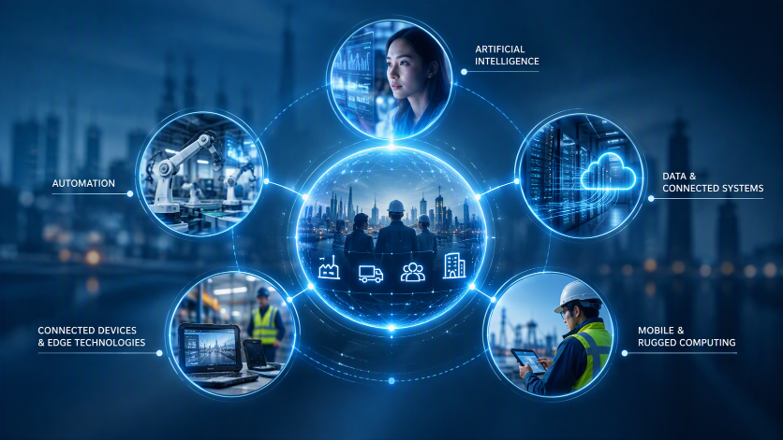
Bring the Right Technologies Together
Digital transformation rarely depends on a single technology. The right combination will vary according to the operational challenge, existing environment and desired outcome.
- Artificial Intelligence
Support information access, intelligent interactions and appropriate automation.
- Automation
Simplify repetitive activities and reduce unnecessary manual steps.
- Connected Devices and Edge Technologies
Extend digital capabilities closer to where operational work happens.
- Mobile and Rugged Computing
Provide access to applications and information across mobile or demanding operational environments.
- Connected Data and Systems
Help relevant information move between people, applications and operational processes.
"The value of these technologies increases when they are selected around a clear business requirement rather than deployed as isolated capabilities."
Business Challenge → Operational Requirement → Technology → Integrated Solution → Business Outcome
From Technology to Integrated Solutions
Technology provides capabilities. A solution brings those capabilities together around a specific operational need.
An organisation may not simply need AI, mobile computing or automation. It may need a better way for employees to access information, a more connected warehouse workflow, or a customer service model that combines digital efficiency with human expertise.
The technology combination should therefore be determined by what the organisation is trying to achieve.
Applying the Approach Across Operations
Manufacturing: Connecting Maintenance and Operational Information
When production or maintenance teams need information from multiple sources, connected systems, operational data and mobile technologies can bring relevant information closer to the workflow.
Logistics: Connecting Physical and Digital Workflows
Warehouse employees often move between physical activities and the systems used to record or manage those activities. A connected approach can bring mobile computing, data capture, connectivity and warehouse systems into the same operational workflow.
Customer Service: Combining AI with Human Expertise
Not every customer interaction requires the same type of support. Routine interactions may be suitable for digital or AI-assisted experiences, while complex enquiries may require human expertise.
"Different operational challenges require different technologies, but the principle remains the same: start with the business need and build the solution around the desired outcome."
Introducing new technology is not the same as achieving transformation
The more meaningful question is whether the solution improves the business or operational challenge it was designed to address.
Depending on the objective, organisations might consider:
- Task completion or maintenance response time
- Reduction in manual or duplicated processes
- Time required to access relevant information
- Equipment downtime
- Inventory or order-processing performance
- User adoption and usability
- Total cost of ownership
"Successful digital transformation should ultimately be measured by what improves, not simply by what technology has been deployed."
Connecting Technology to Real Business Needs
Digital transformation rarely depends on a single product or technology. It requires an understanding of the operational challenge, the existing environment and the capabilities needed to address it.
Panasonic Connect Asia supports organisations in exploring how technologies and solutions can be brought together around real operational requirements, from connected workplaces and mobile operations to AI-enabled customer experiences.
The objective is not technology adoption for its own sake. It is to connect the right capabilities with the right business needs to support more efficient, connected and adaptable operations.
Frequently Asked Questions
Digital transformation solutions combine technologies, connected systems and improved workflows to address operational challenges and support business outcomes.
Start by defining the business or operational problem, understanding the people and processes involved, and identifying the outcome that needs to improve.
Integrated solutions connect relevant capabilities around a common operational need, helping organisations move beyond isolated technology deployments.
It can connect production, maintenance information, operational data and workforce activities around manufacturing workflows.
It can connect physical warehouse activities with mobile access, data capture, inventory information and warehouse systems.
AI can support suitable routine interactions and information access, while human specialists remain available for enquiries requiring judgement or specialist knowledge.
Measures should reflect the intended outcome, such as task completion time, manual process reduction, information access, operational performance, adoption or total cost of ownership.
Ready to Explore What Technology Could Enable for Your Operations?
Talk to Panasonic Connect Asia about your operational priorities and explore the technologies and solutions that could support your next step.



















Share page
Share this link via:
X
LinkedIn
Xing
Facebook
Or copy link: